



Constant clamping force despite fluctuating tightening torques
Thisadaptive bolting procedureensures aconstant clamping forcewhen drive torque values fluctuate. The entire bolt assembly consists of head contact recognition and a bolt assembly at differential torque or at a specific angle.
The typical area of application is direct screwdriving in plastic and/or metal. The patented DEPRAG EC servo screwdriver screwdriving process in combination with AST40 or AST12 is used to tighten a wide variety of torques.
These fluctuations can result from alterations in screw and/or hole geometry, component material structure, variations in screw thread surface quality, element elasticity or seating processes. Reliable head contact recognition results in a constant clamping force.
Advantages:
- Increased preload force consistency
- The calculation takes into account coincident fluctuations in torque during the process, which are not caused by contact with the head.
- Minimum parameter settings
Method of calculation:
The main element is the head contact recognition: based on the torque flow, a mathematical evaluation function is continuously generated. Head contact is considered to be recognized as soon as this function exceeds a fixed limit value. Torque and
angles are calculated backwards until the moment of head contact.
Screwing procedure:
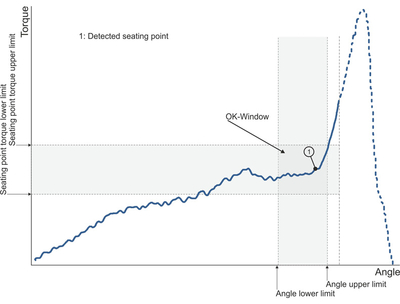
torque procedure – parameter spindle contact recognition screw template
The upper torque limit serves as a closing criterion for the bolting step. The OK window for seat recognition can optionally be monitored using the upper/lower limit of seat torque. The end values can be saved as torque and angle values at the seating point or at the end of the bolting step. The final values of the seating recognition of the bolting template provide the reference for the next section of the program.
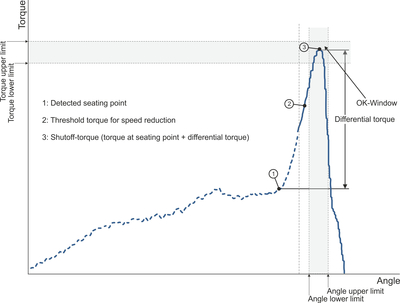
Differential torque bolt assembly related to head contact recognition
The angle bolt assembly can follow in place of the differential torque bolt assembly.


